




Death is the only certainty that everyone has Yet it is the most misunderstood and avoided topic. We think about career paths or relationships, as well as our futures. But we seldom plan conversations about dying. Through the ages and across cultures the world has tried to explain this by using religion, science or philosophy, as well as ritual. Each explanation is not completely complete by itself.
What we know is that death affects how we live. It affects the way we live, our priorities, values, fear and courage, art and the meaning. These ten facts aren’t trying to answer the question of the issue of death. They can help you understand it biologically emotionally, culturally, and how thinking about it with care will enrich your life, not dull it.
10 Facts About Death
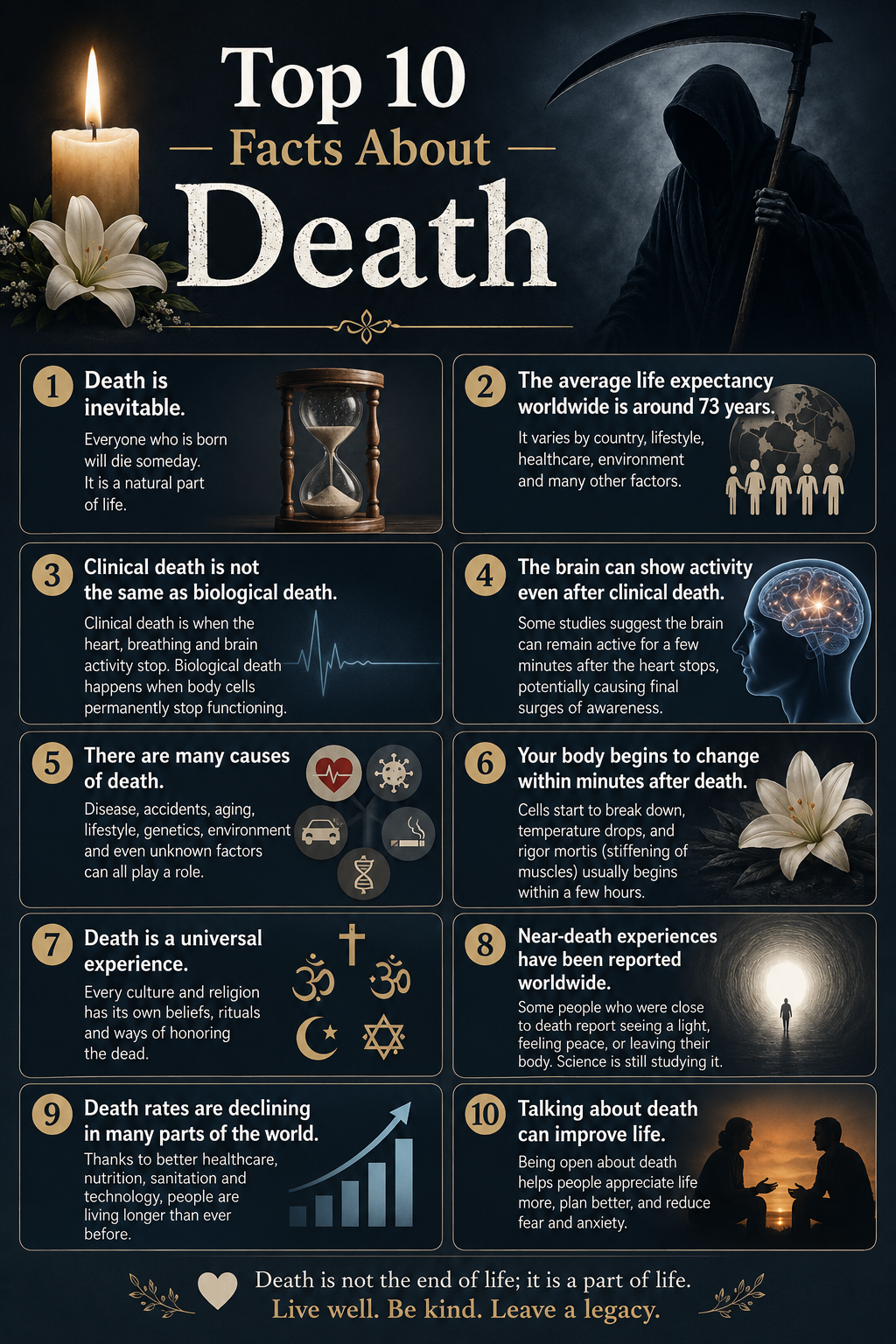
1. Death Is a Process, Not a Single Moment
It is rare for death to be a quick change between “alive” in a flash to “gone.”
Biochemically speaking, it is developed in stages. Organs fail at different times. Brain oxygen levels drop and the heart stops. cells start to die and chemical balances change. After the heart ceases to beat some cells remain active for a few minutes or more.
That’s why medical experts define death with care, using criteria such as brain death or irreversible heart arrest. The definition of death isn’t one second on the clock. It’s a transition.
2. The Body Begins Changing Immediately
After death the body begins to alter with predictable patterns.
As temperatures drop, muscles stiffen and blood pressure rises in response to gravity. These changes don’t indicate decline initially, they are just natural physical responses to the loss of energy and circulation.
Understanding this can help to understand death. The body is governed by biological laws, not a the drama. What appears scary is usually the result of physics and chemistry doing what they do every day.
3. Humans Are the Only Species That Fully Understand Death
Many animals are affected by loss However, humans are the only species to have a tendency to be prepared for death.
We all know that we’ll pass away one day. This knowledge affects language, culture ethics, and even fear. Humans are the reason why they are able to bury their dead, create wills, make up beliefs about the afterlife and inquire about the meaning behind their lives.
The awareness of this can be stressful, but it also inspires the desire to be compassionate, artistic, philosophical and the desire to leave some thing to be left behind.
4. Fear of Death Is Largely Fear of the Unknown
The majority of people don’t worry about death’s moment but they worry about what comes following, or if anything happens anyhow.
The uncertainty is the reason for stories, religions and myths and stories. Cultures come up with explanations that are not just to talk about death, but also to make it more bearable.
It is interesting to note that those who are close to death typically have less fear following the event. A sense of familiarity, even on death’s edge tends to ease terror.
5. Near-Death Experiences Share Common Patterns
In all religions and cultures People report identical near-death experience.
This can be a feeling of peace, disconnection of the physical body a change in memory, vivid experiences or experiences with lights. Scientists explain some of these through brain chemistry as well as oxygen deficiency.
What is important isn’t whether the experiences provide evidence beyond what we can imagine. It’s how profoundly they impact people, often lessening fear and increasing empathy.
6. Death Is One of the Biggest Drivers of Human Culture
All civilizations are built around death.
Memorials, graves, pyramids rituals, and mourning rituals are everywhere that humankind has lived. Music, poetry, art and religions all wrestle with the idea of death.
The laws and even the governments are influenced by death, inheritance and justice, punishment and conflict. A lot of human organizations exist because of the limitations of life.
7. Thinking About Death Can Improve Mental Health
It may sound strange It may sound odd, but it’s actually true.
Studies have shown that positive reflection on death, also referred to as “mortality awareness”–can help reduce anxiety, increase focus and enhance gratitude. If people accept the natural death of their loved ones and inevitable, they tend to live their lives more mindfully.
Avoidance can increase anxiety. Awareness can provide clarity. Death doesn’t cheapen life–it defines it.
8. Most People Do Not Die the Way They Fear
Many are afraid of dying from fear, panic or in chaos.
With good treatment, the majority of deaths — especially those caused by the effects of old age or illness are peaceful. In the body, it naturally produces chemical that ease anxiety and pain. Medical care also focuses on ease of.
The dramatic deaths in movies are uncommon. The quiet endings are much more frequent.
9. Death Changes the Living More Than the Dying
If someone dies the pain is over.
For those who have been left by their loved ones, the world changes forever. Grief alters the way we view ourselves, our relationships and even time itself. It doesn’t disappear in an unidirectional way. It is a wave.
However, grief can also increase empathy. People who have suffered loss tend to have a better understanding of life. Death shows the living how fragile, and precious, connection really is.
10. No One Has Ever Escaped Death–but Everyone Shapes Its Meaning
Despite all the progress the human race has not escaped death.
The only thing that changed or has changed is the way that we perceive the process. More life-long lives, better medical care and better understanding have influenced how and when people die, but it’s not that they die.
The only thing that is truly human is decision-making: how we will face death, discuss it and prepare for it and let it guide our lives.
Conclusion
Death is not the end of life. It’s a part of it. Every breath is important because it will end. Every relationship is important because it will not be around for ever. The death of a relationship doesn’t erase its meaning, it makes it.
If we stop putting death as taboo and begin to view death as an inevitable border life becomes clearer and more authentic, as well as more urgent. There’s no need to be afraid of death to be able to accept it. It’s not necessary to find a solution to it in order to be happy with it.
The end of the day, death does not call us to be scared. It is asking us to pay attention to people, to time and to moments that we tend to rush by. The time is limited. This is precisely why it’s important.