





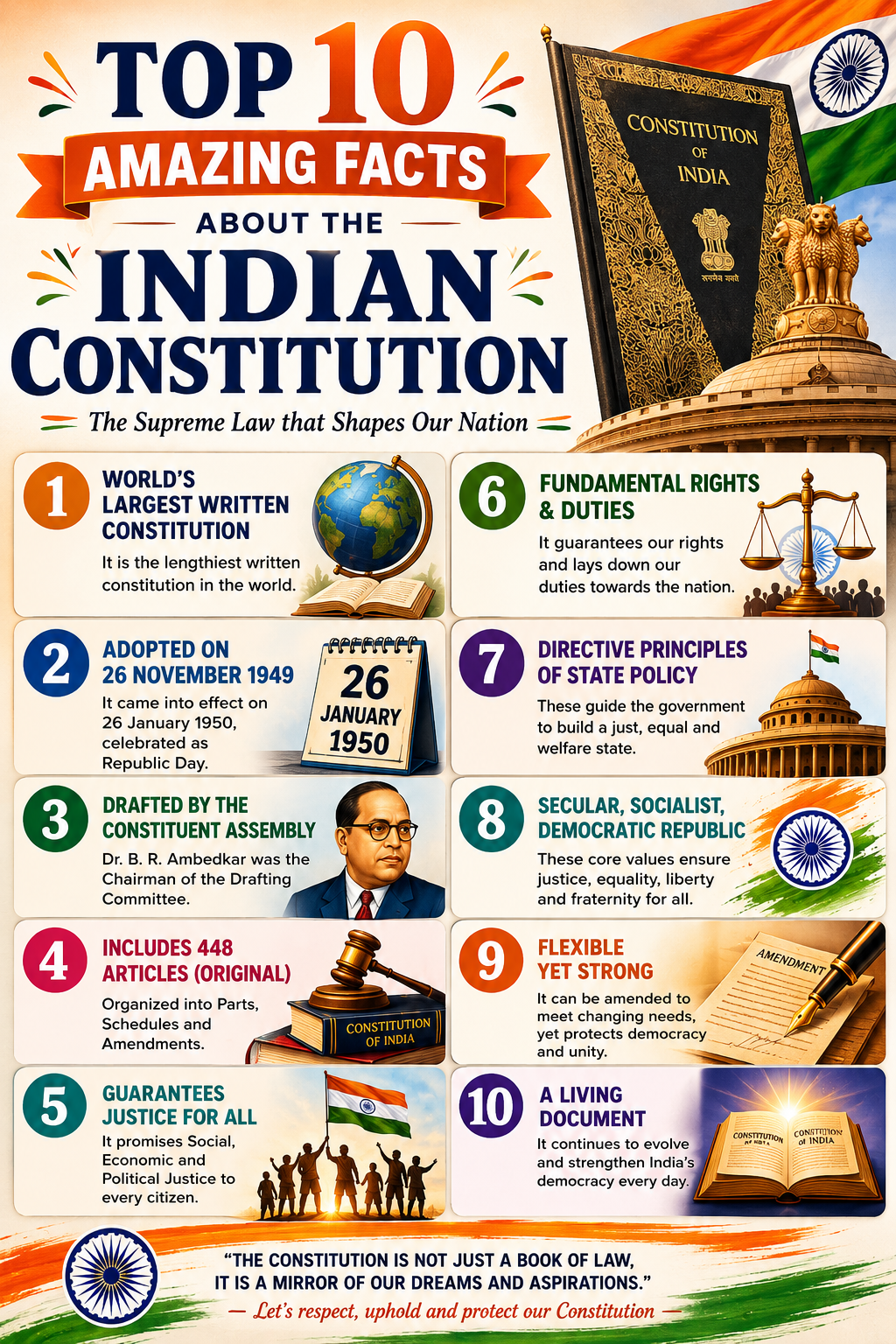
Constitution of India is not simply an official document. It is the foundation of the world’s biggest democracy, as well as a living manual which determines how more than one billion people are managed. Although the majority of people read about it in books or on exams, very few are aware of the uniqueness the system is and how well designed it really is.
The Indian Constitution was drafted in a period in which the country was just becoming independent, deeply diverse and faced with enormous problems. However, it was able to achieve unity, without imposing uniformity. These ten incredible facts demonstrate the reasons why it is that the Indian Constitution is considered one of the most impressive Constitutional documents ever created.
10 Amazing Facts About the Indian Constitution
1. The Indian Constitution Is the Longest Written Constitution in the World
The Indian Constitution holds a global record.
The Constitution is among the longest-running constitution written by any sovereign nation. When it was first put into adoption, it had three hundred and twenty-two Articles as well as 22 Parts as well as 8 schedules. Through the years, modifications have expanded the scope of the law.
This length was deliberate. India’s founders wanted to address the country’s vast diversity–languages, religions, cultures, and social systems–within one legal framework. Instead of making things unclear they decided to focus on the clarity and specificity to avoid confusion and misuse of power.
2. It Took Almost 3 Years to Write
The draft of Constitutional amendments Indian Constitution was not rushed.
It took two years, eleven months as well as 18 days to finish. It was completed in Constituent Assembly held 11 sessions and debated nearly every phrase thoroughly. Every clause was debated in detail, debated, amended, and reworked.
The long-running process made sure that the Constitution did not only reflect concepts of politics, but also the reality of society. The Constitution was not drafted to be a single generational document however, but rather to reflect an era of nation that was still trying to figure out its own identity.
3. Dr. B. R. Ambedkar Was the Chief Architect
R. Ambedkar is widely thought of as the main designer for India’s Constitution. Indian Constitution.
As Chairman of the Drafting Committee, he played an integral role in defining the structure and guiding principles. His profound knowledge of the law, economics and social justice aided to ensure the protection of equality and rights for individuals.
Ambedkar stressed constitutional morality, which is respect for the rules, institutions and democratic principles. He believed that the political system could not be sustained in the absence of social democracy which makes the concept of equality and dignity a central part of the Constitution.
4. The Constitution Was Handwritten, Not Printed
The most interesting facts is the way in which the Constitution was drafted physically.
These original documents are written by hand and exquisitely calledigraphed with both English in both English and Hindi. The calligraphy was performed by Prem Behari Narain Raizada as well as each one was adorned with illustrations that was inspired by Indian cultural traditions.
There were no printed or typing used in the original version. This artful effort spelled respect for the document, and made it an important national treasure, not just a manual for legal purposes.
5. It borrows ideas from many Countries
The Indian Constitution is sometimes referred to as”borrowed Constitution” or a “borrowed Constitution” yet that’s the truth. Its strength is.
The constitution’s creators examined constitutions from around the globe, and chose concepts that were most appropriate for India. Fundamental Rights were influenced from Constitutional principles from the U.S. Constitution, Directive Principles from Ireland as well as parliamentary governance in The U.K., and emergency clauses from Germany.
Instead of blindly copying this idea was adapting for Indian conditions. It was the result of a well-balanced system that combined authority, liberty as well as flexibility and accountability.
6. It Declares India a Sovereign, Socialist, Secular, Democratic Republic
The Preamble to the Constitution clearly defines the Indian identity.
This declaration states that India as sovereign and secular, socialist democratic, democratic and an independent republic. These words are not merely for show. provide the basis for governance and lawmaking.
Secularism in India signifies an equal amount of reverence for the various religions, and not hatred of the faith. Socialism emphasizes economic and social justice. Democracy is the system that transfers power from the people. A republic refers to the fact that the head of state is elected, not inherited.
7. Constitutional Rights protect citizens from being ruled by the state
The Constitution’s most powerful aspects includes Fundamental Rights.
They protect citizens from being subject to arbitrary decisions by the state. They protect citizens from discrimination before the law as well as freedom of speech, security of life and liberty as well as the right to freedom of religious belief.
If the rights of citizens are violated, people can direct the justice system directly. This makes rights legally binding and not just only symbolic. This ensures that the government is accountable to the citizens in all times.
8. Directive Principles Aim to Build a Welfare State
In addition to rights In addition to rights, the Constitution is also a source of Directive Principles of State Policy.
These are the principles that guide the government when it comes to making laws to promote social justice, reduce inequality, and guarantee the rights of all. They cover issues such as free education and equal pay, as well as public health as well as the protection of the environment.
While they aren’t legally binding but they function as moral guide. Many of the progressive laws in India are based on these fundamentals.
9. The Constitution Is Flexible Yet Strong
The Indian Constitution strikes a rare balance between flexibility and rigidity.
Some provisions can be changed by a simple majority however, others require a majority of the states and their approval. This is to prevent misuse, while also allowing the possibility of adaptation as time passes.
Due to this flexibility, the Constitution has been able to withstand the rigors of social and political reforms, and economic shifts without losing its fundamental values.
10. The Constitution Is a Living Document
The most remarkable thing is the fact that the Indian Constitution is still in existence.
It evolves through modifications in judicial interpretations, amendments to the law, and changes in society. The courts constantly interpret its rules to address modern issues like privacy in the digital age environmental protection, as well as gender equality.
Despite being written decades ago, its values remain relevant because they are rooted in justice, liberty, equality, and fraternity–principles that never go out of date.
Conclusion
The Indian Constitution is not just about laws, but also about vision. It’s a bold attempt to bring together a wide range of people in a common set of values. It safeguards freedom and demands accountability. It reduces power while encouraging individuals.
In a nation as large with complexities as India the Constitution functions as a peaceful force that keeps everything in place. The Constitution isn’t just for lawyers or students, it is for everyone who gains of its safeguards.
In India, the strength of its democratic system ultimately is not dependent on the words in its Constitution but the extent to which its principles are respected and carried out every day.