





Sparrows are so ubiquitous that they are often overlooked. their presence. They scurry across sidewalks, hang out on electric wires, talk on rooftops, and then disappear into the hedges and bushes without drawing attention. In contrast to exotic birds sporting striking feathers or arousing calls, sparrows can be found peacefully with humans. However, their closeness conceals the truth behind their extraordinary stories.
Sparrows are a species that has survived. They’ve adapted to cities or villages, farms and harsh climates around the globe. Their lives are closely tied to the human past as well as agriculture and urbanization. These ten facts will show that the sparrow’s humble existence is much more sophisticated, smart, and significant than what it seems.
10 Interesting Facts About Sparrows
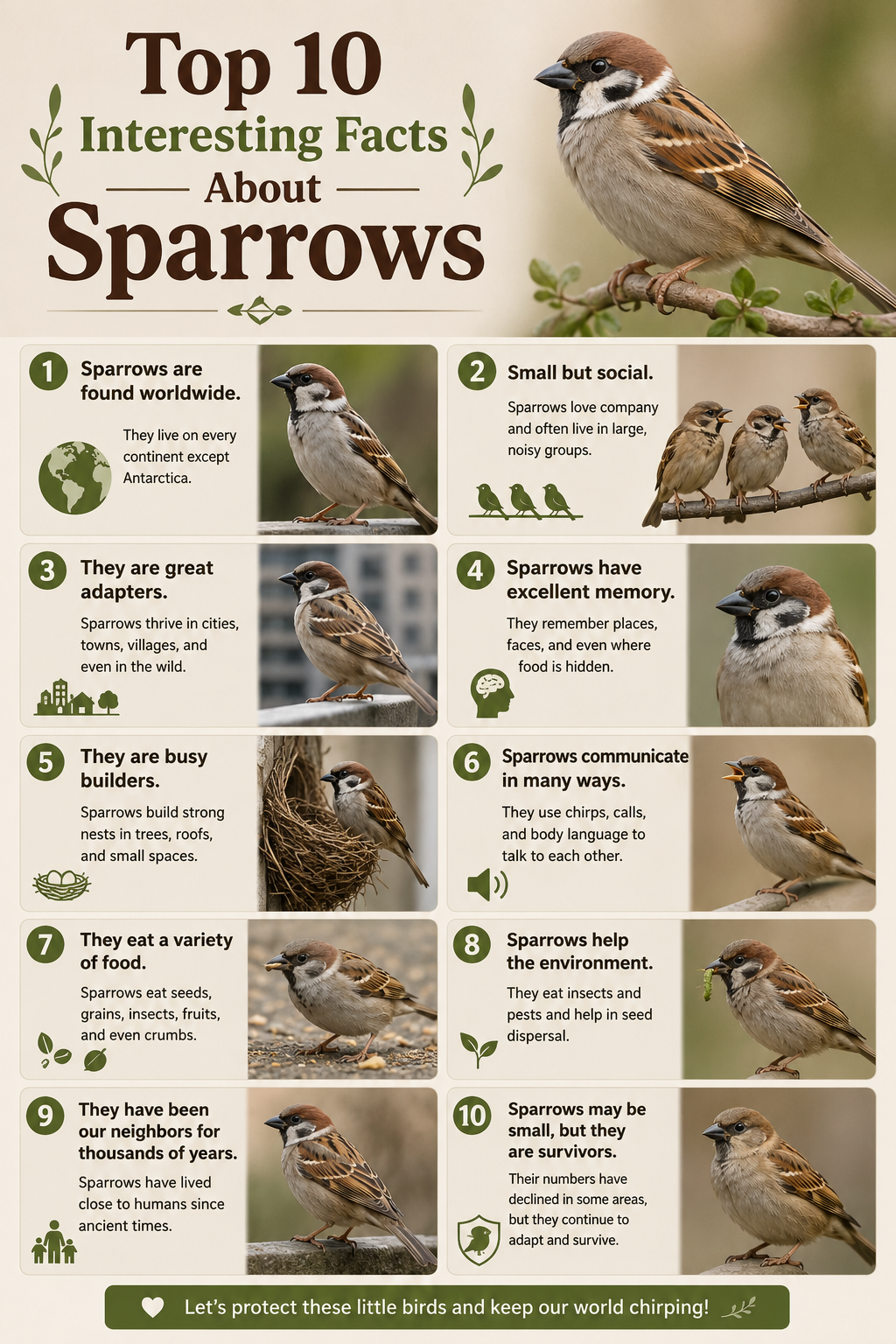
1. Sparrows Have Lived Alongside Humans for Thousands of Years
Sparrows don’t just get lucky to be near humans, they made the decision to.
When early humans started harvesting and storing grains sparrows spotted a great opportunity. They quickly adapted to the human-made settlements grazing on the leftover grains and settling in structures. As time passed, sparrows became among the very first species of wild bird to be able to live completely alongside humans.
This long-running partnership explains how sparrows are so comfortable. They aren’t nature birds that are visiting cities. The cities became their habitat.
2. There Are Many Species of Sparrows
When people hear “sparrow,” they usually think of just one bird.
In the real world there are several kinds of species of sparrows that are found all over the globe. They are found in deserts, while others live in grasslands, mountains, or in dense cities. They differ in terms of size in size, color, behavior and songs.
What unites them is their ability to adapt. Anywhere humans go, a certain type of sparrow is usually there.
3. Sparrows Are Extremely Social Birds
Sparrows seldom live in solitude. They are at home in groups known as flocks. They provide security as well as warmth and information. When one bird finds food, the others follow. If danger is detected alarm calls are instantly broadcast.
Social interaction also helps sparrows endure cold winter days. They typically gather together during the night to save heat and show that cooperation is a viable strategy for survival.
4. Sparrows Are Smarter Than They Look
Despite their tiny size, sparrows are smart birds.
They identify patterns, develop routines and recall the locations of food. Sparrows are quick to understand human behavior, such as when food is available or when danger is imminent and where they are secured.
In urban areas, sparrows adjust to noise from traffic and crowds as well as changing conditions. Their ability to adapt and adapt is a major reason they’ve survived when other birds haven’t.
5. Sparrows Communicate Constantly
The nonstop chirping and chirping of sparrows isn’t random.
They make different sounds to convey the dangers, the search for food in mating, as well as social bonds. Their calls might sound easy to humans however, to other sparrows they convey a wealth of information.
The constant communication allows flocks to remain vigilant and organized particularly in urban areas that are rife with dangers.
6. Sparrows Build Nests Almost Anywhere
Sparrows are masters of opportunism in the field of nesting.They make nests in roofing tiles, inside the gaps in walls, inside the streetlights and on store signage and even inside abandoned machines. The nests are messy, but efficient, constructed of feathers, grass, paper and any other material they find.
This flexibility lets sparrows raise chicks in heavily constructed zones where natural nesting areas are scarce.
7. Sparrows Play a Big Role in Ecosystems
Although they are small, sparrows play an important ecological function.
They eat insects during the breeding season and help in the control of pest populations. They also distribute seeds and act as prey to larger animals and birds.
If you remove sparrows, the balance of ecosystems in local areas starts to shift. Their disappearance is often a sign of more serious environmental issues.
8. Sparrows Can Recognize Individual Humans
Research and observations have shown that sparrows detect human faces.
They are aware of which human beings are feeding them, and also which ones pose danger. As time passes, they become at ease with familiar faces and are wary of strangers.
This skill shows a high level of cognition and awareness. Even for a bird of such small size the sparrows are adept viewers of everything surrounding them.
9. Sparrow Populations Are Declining in Many Cities
Despite their versatility the sparrows are disappearing from the urban landscape in.
The effects of pollution, the loss of nesting areas glass structures pesticides, and the absence of insect populations have decreased their number. Modern architecture usually leaves no spaces for nesting and chemical use decreases the food sources.
The decline in sparrows is an alarm signal. If the birds that are most adaptable fight, it could indicate severe environmental stress.
10. Sparrows Symbolize Simplicity and Home
In all cultures, sparrows symbolize simplicity, humility, and every day life.
They aren’t images of beauty or power they are symbols of belonging. Poetry and writers have frequently used sparrows as a metaphor for the ordinary person, their who are able to remain quiet and have a subtle force.
Their presence is a reminder that nature doesn’t always speak. Sometimes, it whispers from rooftops wires, cables, and even tiny spaces that we don’t notice.
Conclusion
Sparrows aren’t uncommon and loud. They are also colorful, and this is precisely the reason they are important. They live in our homes, streets and lives, without requiring attention. Their survival is contingent on the way we design our surroundings.
If the sparrows are flourishing they mean that the environment remain alive in tiny delicate shapes. If they disappear there is something vitally missing. The sparrow is a great teacher of a lesson: success isn’t always a matter of spectacle. Sometimes, it flits in your midst, making chirping sounds about a world that’s gradually changing.
If we can learn to recognize sparrows once more, we could be able to take better care of the areas we share.