





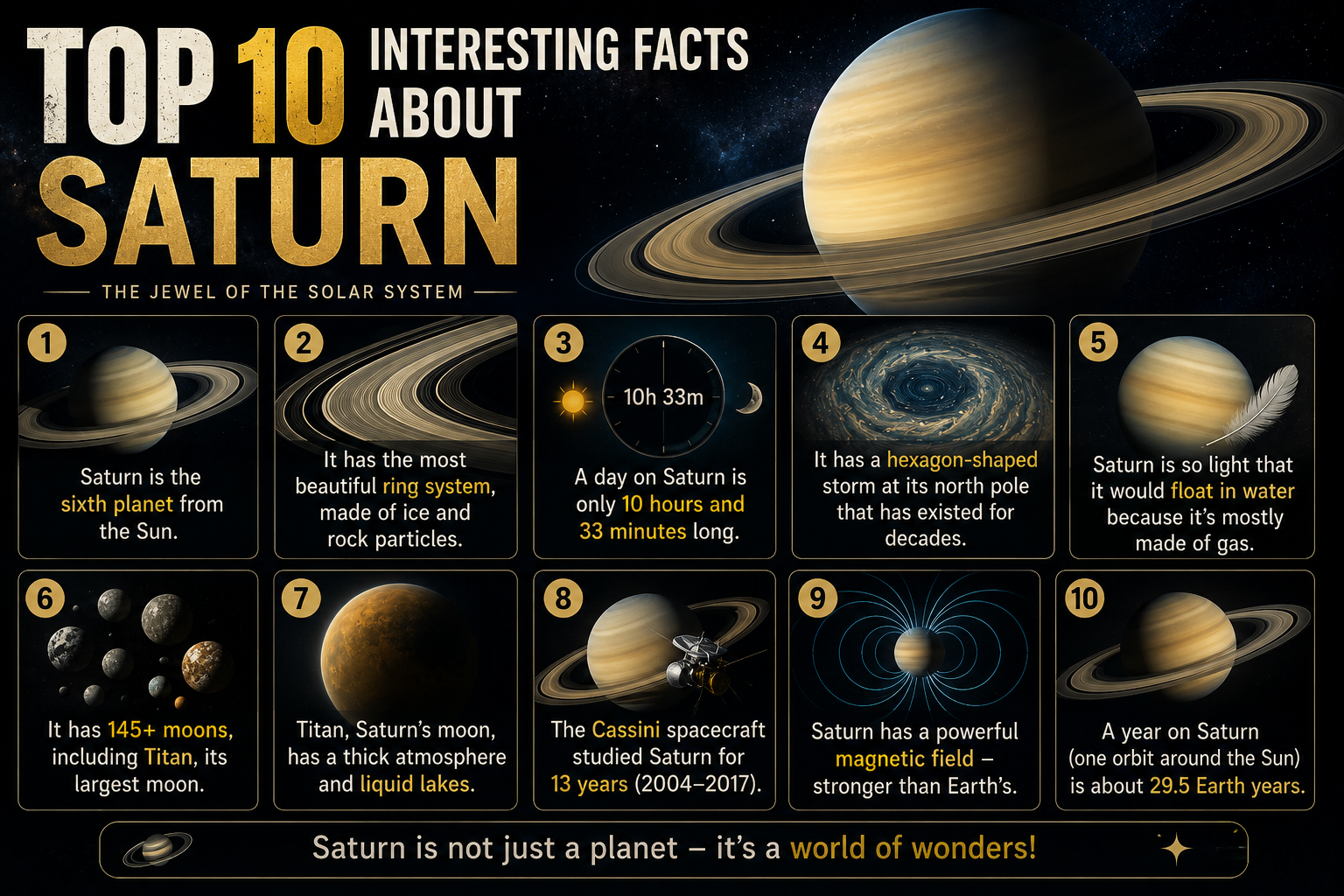
Saturn appears serene far away, but also artful when viewed from space. Its soft, smooth rings and golden hue make it appear serene, and even soft. However, beneath all that beauty is the planet of extremes: violent hurricanes and storms that pound at the pressure cold temperature, as well as forces that are so strong they can bend matter. Saturn isn’t silent simply because it is easy. It’s quiet because it is old enormous, huge, and full of mystery.
Examining Saturn provides us with a crucial knowledge about our universe. Things don’t always look as they appear at first. It is possible to look stylish when you are strong. Danger can be stunning. It’s possible to move in a slow pace and alter everything. With this to keep in mind take a look at the 10 Interesting Facts About Saturn and find out why the planet continues to be a fascination for scientists as well as sky-watchers.
1. Saturn Is the Least Dense Planet in the Solar System
Saturn is huge it is the second largest planet after Jupiter in size, but it’s surprisingly light in comparison to its size. It is also the the smallest and least dense planet in the solar system.
In theory, if there was an adequate bathtub, Saturn could float in the water. This odd fact is due to the composition of Saturn. Saturn is mostly composed by hydrogen as well as helium. the two heaviest elements in the universe. It teaches us that size doesn’t necessarily mean solidity.
2. Saturn Is Mostly Gas and Has No Solid Surface
In contrast to Earth, Saturn does not have a solid, solid surface that can sit on. As you progress deeper into the planet gas becomes more dense until it becomes liquid.
There is no straight line between where the the sky ceases and earth starts. Pressure rises so rapidly that atoms are forced to enter bizarre state. Saturn is composed of layers and not on the land. It challenges our notion of what an “planet” ought to be.
3. Saturn’s Rings Are Made of Countless Pieces
Saturn’s rings appear as smooth bands, but they’re actually made of billions of tiny pieces of rock and ice.
Certain particles are as small as dust grains, whereas some are as big as houses. Each particle revolves around Saturn in its own way, held together by gravity. The rings are huge but extremely thin, demonstrating how something small may appear huge from a distance.
4. The Rings Will Not Last Forever
A number of fascinating discoveries concerning Saturn is the fact that the rings of Saturn are gradually disappearing.
Solar radiation and gravity are dragging the ring material into the Earth in a process known as “ring rain.” In hundreds million years the rings could disappear completely. Saturn offers a simple truth that even the most famous beauty of the universe can be only temporary.
5. A Day on Saturn Is Very Short
Saturn is extremely fast spinning. A full day on Saturn will last only 10.7 minutes.
This fast rotation causes Saturn to expand at the equator, and then flatten in the poles. Saturn appears to be squashed due of the speed alone. Motion determines its appearance which shows how movement can be a marker of identity at a planet-wide scale.
6. Saturn Has the Most Moons in the Solar System
Saturn is currently the record holder for the largest number of moons that orbit the planet. Each moon is unique and each has its own history and surroundings.
Some moons are cold and reflective. Other moons are dark and rocky. Titan the largest moon, is home to lakes and rivers, but not out of water, but instead composed of methane, a liquid. Enceladus sprays water out into space, revealing hidden oceans under the glaciers. Saturn isn’t only one planet it is a complex system that includes many.
7. Saturn’s Winds Are Incredibly Powerful
In spite of its tranquil exterior, Saturn is a world full of storms. The winds on Saturn are capable of exceeding 1800 km/h and are more powerful than any storm on Earth.
They can last for a long time. The most elusive characteristics is the hexagonal storm that is located at the north pole of Saturn. It’s a perfect, long-lasting weather pattern that scientists have yet to comprehend. There is order even in chaos.
8. Saturn Is Extremely Cold
Since Saturn is so far away from the Sun and is far from the Sun, it gets less warmth than Earth. Temperatures can fall to -178°C..
In these cold temperatures the normal chemistry alters. Materials and gases are able to freeze. react differently. While Saturn is not able to support the way we think of the term, it’s moons could provide conditions to help scientists determine if life exists somewhere else in the universe.
9. Saturn’s Gravity Controls Everything Around It
The gravity of Saturn is massive. It affects the movement of its moons, rings as well as the space debris that is close by.
There is nothing in the vicinity of Saturn can move without restriction. Everything is affected, guided or held by gravity’s pull. It is invisibly, yet its power is unquestionable. Like invisible forces in our lives it affects outcomes regardless of regardless of whether we are aware of it or not.
10. Saturn Helps Scientists Understand the Origin of the Solar System
Saturn is an archive of time that dates back to the beginning that the solar system was in its beginning. Its composition provides clues to the formation of planets millions of years ago.
When looking at Saturn scientists discover not only about one planet, but also about the birth of planets everywhere. Saturn helps us to understand the history of Earth and perhaps humanity’s place in the universe of stars.
Conclusion
Saturn is an earth full of contrasts. It is huge yet thin, beautiful but also perilous, old and slow to change. Its rings shine brightly even as they dim. The storms that rage in the sky are quiet without being seen from Earth.
A look at Saturn is much more than an cosmic experience. It’s a reminder of how strength isn’t always obvious and beauty is a fleeting thing but time will always leave its impression. Through its quiet orbit, Saturn is a reminder to be more than the appearance of things and to take note of the forceful forces shaping the world around us.