


Introduction
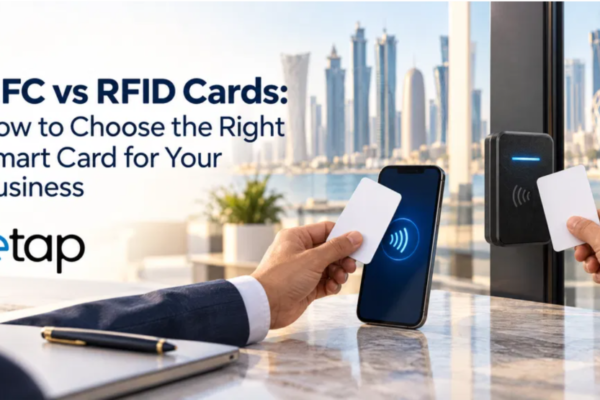
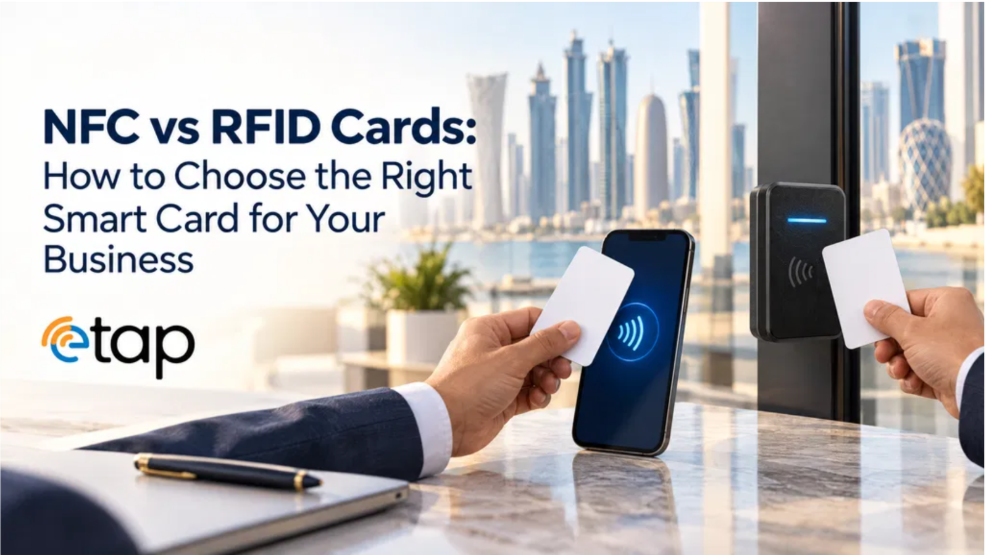
Smart cards support a range of business activities, from sharing contact details to identifying members and controlling access to buildings. Two terms often appear in product descriptions: NFC and RFID. They are related, but they are not interchangeable labels for every application. Understanding the difference helps organisations select a card that matches their use case, phones or installed readers. NFC is a short-range technology within the broader RFID family. Businesses can begin by comparing etap’s NFC cards and RFID cards, while checking their own system requirements.
What is RFID?
RFID stands for Radio Frequency Identification. An RFID system typically includes a tag or card, a reader and software that interprets the information. The card contains a chip and antenna; when it comes within the reader’s operating range, radio-frequency signals allow information to be exchanged. RFID is used in access control, asset identification, inventory processes, membership systems and logistics. The range, frequency and security capabilities vary by technology, so the reader and card must be compatible.
What is NFC?
Near Field Communication is a short-range contactless technology commonly used for tap interactions with compatible smartphones and tags. An NFC card may store a URL that opens a digital business profile, menu, review page or other web destination. Many NFC tags are passive and draw the energy required for communication from the reader’s field, so they do not need a battery for ordinary tap-to-open actions. NFC is useful when the goal is to make a digital destination easy to reach at close range.
Key differences
**Scope:** RFID is the broader family of technologies, while NFC is one specific short-range technology. **Typical use:** NFC is commonly used for smartphone taps, digital business cards and review links. RFID also includes many access-control and identification systems. **Range:** Different RFID technologies can operate at different ranges; NFC is designed for close proximity. **Compatibility:** A smartphone that reads common NFC tags will not automatically read every credential used by a building access system. **Security:** Neither term guarantees a particular security level. Security depends on the chip, protocol, authentication features, configuration and credential-management process.
Which card suits your business?
For professionals who want to share a digital profile, website or portfolio by tapping a phone, an NFC digital business card is usually a natural fit. Compare styles and materials in etap’s digital business card collection. For a workplace that needs staff credentials at door readers, ask the installer to specify the required technology before ordering. Depending on the system, an RFID or MIFARE card may be suitable; see etap’s MIFARE card page as a reference. For printed employee identification, review etap’s PVC ID cards.
Questions to ask before purchase
Identify the intended use first. Which device will read the card? What frequency, chip family and protocol does it require? Does the card need to store a URL, a credential identifier or another data format? Is the card intended for public smartphone tapping or a managed access system? Will it require printing, a photograph, a barcode or a QR code? Who will encode, test, issue and deactivate credentials? For access control, confirm details with the system provider rather than relying on a generic product label. For NFC web links, test the destination on compatible phones and include a QR alternative when useful.
Security and maintenance
For access-control cards, keep a register of issued credentials and define how lost cards are disabled. Use the security features supported by the system and remove permissions when an employee leaves or a visitor pass expires. For NFC business cards, check that the linked profile is accurate and that public information is appropriate to share. Keep URLs current and test them periodically. Clear ownership of card programming and profile updates helps avoid confusion as teams and systems change.
Conclusion
NFC and RFID technologies can both make business interactions more convenient, but the right choice depends on the task. NFC is well suited to close-range smartphone interactions, while RFID covers a broader range of identification and access applications. Confirm compatibility before ordering, test samples and consider how credentials or digital profiles will be maintained. Explore etap’s NFC cards, RFID cards and MIFARE cards as part of your research.