




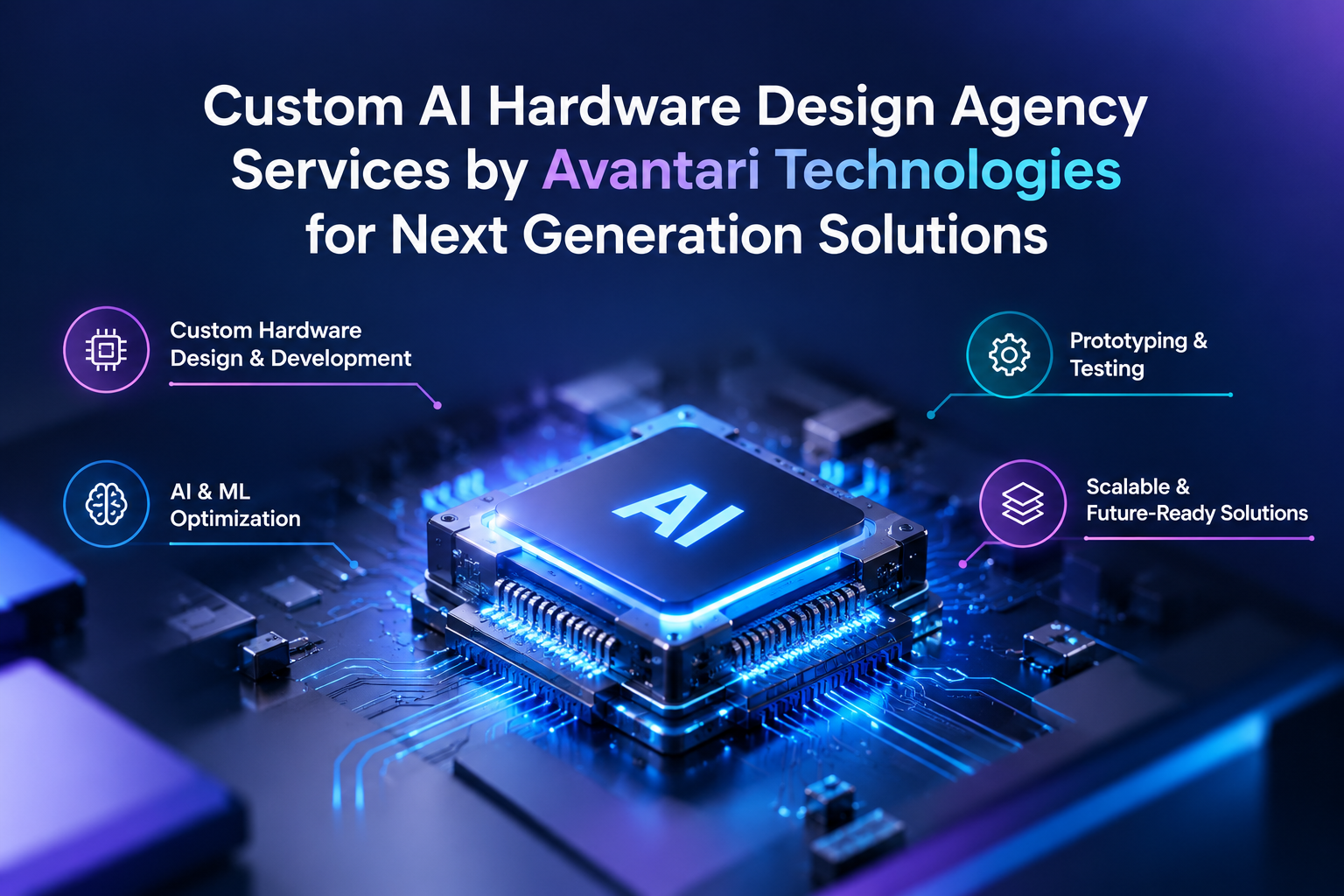
Artificial intelligence is transforming how businesses design, develop, and deliver innovative products. From intelligent consumer electronics to industrial automation systems, AI-powered devices are creating new opportunities for companies across multiple industries. However, developing successful AI products requires more than advanced algorithms and software. It also requires reliable hardware, efficient processing capabilities, carefully designed electronic circuits, and seamless integration between physical components and intelligent systems.
This is where a Custom AI Hardware Design Agency becomes valuable. By combining electronic engineering, embedded systems, hardware architecture, and AI integration, businesses can develop products that meet specific performance, power consumption, size, and cost requirements. Avantari Technologies operates in the product engineering space, supporting businesses that are exploring innovative hardware and technology solutions for evolving market demands.
As organizations increasingly adopt intelligent technologies, customized hardware development is becoming an important part of building next-generation solutions. Understanding the services involved in this process can help businesses make informed decisions about product development and long-term innovation.
Understanding Custom AI Hardware Design Services
Custom AI hardware design involves developing electronic systems and hardware architectures tailored to the requirements of a particular AI application. Instead of relying entirely on standard hardware configurations, businesses can choose components and system designs that support their product’s intended functionality.
For example, a smart camera may require image-processing capabilities, a suitable processor, memory, and wireless connectivity. An industrial monitoring device may need specialized sensors, reliable communication interfaces, and efficient power management. A wearable AI device may prioritize compact dimensions, low energy consumption, and comfortable integration into its physical enclosure.
Each application presents different technical challenges. A customized design helps engineers balance these requirements while considering product reliability, manufacturing feasibility, and future scalability.
A Custom AI Hardware Design Agency can help businesses evaluate these factors during the early development stages. This structured approach allows product teams to establish technical priorities before investing heavily in prototyping, tooling, and manufacturing.
Key Services Offered by a Custom AI Hardware Design Agency
AI hardware development involves multiple engineering disciplines that must work together. Understanding the major services can help businesses identify the capabilities required for their projects.
1. AI Hardware Architecture and System Design
Hardware architecture defines how the different components of an AI-powered product interact. It establishes the foundation for processing, memory management, sensor integration, communication, and power distribution.
The process usually begins with understanding the product’s functional requirements. Engineers identify the intended AI workloads, expected data volumes, processing speed, physical limitations, and operating conditions.
Based on these requirements, they can evaluate suitable hardware platforms and determine how the system should be organized. The architecture may include a microcontroller, application processor, AI accelerator, memory modules, sensors, and communication interfaces.
For example, an AI-enabled industrial inspection system may need to analyze images in real time. Its architecture must support image acquisition, data transfer, model execution, and output communication within acceptable latency limits.
Careful planning at this stage helps reduce compatibility issues and creates a clearer development roadmap. Avantari Technologies is relevant to organizations exploring product engineering solutions where hardware architecture and technology integration are important considerations.
2. Custom PCB Design and Electronic Engineering
Printed circuit board design is an essential part of developing reliable AI hardware. A PCB connects electronic components and provides the electrical foundation required for a device to operate.
AI-enabled products may contain processors, memory, sensors, wireless modules, power management circuits, and other specialized components. Integrating these elements requires careful attention to circuit design, component placement, signal integrity, and thermal performance.
A well-designed PCB can help improve electrical reliability, reduce electromagnetic interference, and support efficient power delivery. Engineers must also consider the physical dimensions of the board and its compatibility with the final product enclosure.
For compact devices, these requirements become particularly challenging because limited space must accommodate multiple electronic functions without compromising performance.
PCB engineering may include schematic development, component selection, circuit simulation, layout design, design reviews, and prototype testing. These activities help identify potential issues before a design moves toward manufacturing.
Working with a Custom AI Hardware Design Agency can help businesses develop circuit boards that align with their processing requirements, product dimensions, and production objectives.
3. Embedded Systems Development
Embedded systems combine hardware and software to perform specific functions within an electronic product. They are fundamental to many AI applications because they coordinate sensors, processors, communication modules, and control functions.
Embedded development may involve firmware programming, peripheral integration, device drivers, communication protocols, and hardware-software testing.
Consider a connected monitoring device that collects temperature and vibration data from industrial equipment. Its embedded software must collect measurements, process incoming data, communicate with the relevant computing platform, and respond to defined conditions.
If AI is integrated into the device, the embedded system must also support the model’s computational and memory requirements. Engineers may need to optimize data movement, manage limited resources, and ensure that AI inference does not interfere with other critical device functions.
Reliable embedded development helps transform individual electronic components into a functional product. It also supports maintainability and future updates as business requirements evolve.
4. AI Processor Selection and Edge Computing Integration
Selecting an appropriate processor is one of the most important decisions in AI hardware development. Different applications require different levels of computational performance, memory capacity, and energy efficiency.
Depending on the use case, engineers may evaluate microcontrollers, application processors, graphics processing units, neural processing units, field programmable gate arrays, or specialized AI accelerators.
A lightweight sensor device may require only modest local processing. In contrast, a computer vision application that analyzes high-resolution images may require substantially greater computational resources.
Edge AI adds another consideration by allowing AI models to run directly on a device or nearby computing platform rather than relying entirely on cloud infrastructure.
Local inference can reduce network dependence, improve response times, and limit the amount of data transmitted to external servers. However, it also requires careful optimization of the model, processor, memory, and power budget.
A Custom AI Hardware Design Agency can help businesses assess these trade-offs and select an architecture suited to their particular application. The objective is to deliver the required functionality without introducing unnecessary hardware complexity or cost.
5. Sensor Integration and Intelligent Device Connectivity
Many AI-powered products depend on sensors to collect information about their surroundings. Cameras, microphones, accelerometers, temperature sensors, proximity sensors, and environmental monitoring components can provide the data needed for intelligent analysis.
Integrating these components involves selecting suitable sensors, designing electrical interfaces, evaluating data quality, and ensuring compatibility with the processing platform.
Connectivity is equally important for products that exchange information with other devices or digital platforms. Depending on the application, a system may use Wi-Fi, Bluetooth, cellular connectivity, Ethernet, or other communication technologies.
For example, a smart building device may combine environmental sensors, embedded processing, and wireless connectivity to monitor room conditions and support automated control.
Engineers must consider signal quality, power consumption, communication reliability, and security requirements throughout the design process.
Effective sensor and connectivity integration helps businesses create intelligent devices that can collect useful information and respond appropriately to changing conditions.
How Custom AI Hardware Supports Next Generation Solutions
Customized hardware is particularly valuable when businesses need to develop products with specific operational requirements. It enables engineering teams to optimize the complete system rather than focusing on individual components in isolation.
Improving Performance and Processing Efficiency
Different AI applications have different computational demands. Custom hardware architecture helps businesses select components that support their required workloads while avoiding unnecessary processing overhead.
Hardware acceleration, efficient memory utilization, and optimized data pathways can improve performance for suitable applications.
For example, an AI-powered inspection device may need to process images quickly enough to identify manufacturing defects while products move along a production line. A properly selected processor and carefully designed data pipeline can help the system meet its response-time requirements.
Supporting Compact and Energy-Efficient Devices
Portable electronics, wearables, and battery-powered IoT products must balance functionality with size and energy consumption.
Custom hardware design can support this objective through appropriate component selection, efficient power management, and careful circuit layout. Depending on the application, engineers may also evaluate sleep modes, dynamic power management, and low-power processing techniques.
These decisions can improve operating efficiency while helping businesses develop products that fit their intended physical form.
Enabling Product Differentiation
Standard hardware platforms are useful for many applications, but they may not always satisfy specialized product requirements.
Customized electronics can help businesses create differentiated devices through unique sensor combinations, specialized interfaces, application-specific processing, or compact mechanical integration.
For startups, this can provide opportunities to develop products around a clearly defined customer need. For established organizations, it can support the expansion of existing product lines with additional intelligent capabilities.
Preparing Products for Scalability
A successful prototype does not automatically guarantee a commercially viable product. Hardware must also be suitable for repeatable manufacturing, component sourcing, testing, and long-term maintenance.
Considering these factors early can reduce redesign efforts when a product moves toward larger production volumes.
Engineers should evaluate component availability, assembly requirements, quality control, expected product lifespan, and potential substitutions. They should also establish appropriate validation procedures to confirm that manufactured units meet the intended specifications.
Industries Benefiting from Custom AI Hardware Design
Custom AI hardware can support innovation across multiple sectors, although the required engineering approach varies by application.
Healthcare and Medical Technology
Healthcare devices can use AI to analyze images, process physiological measurements, support monitoring, and assist with selected diagnostic workflows. Hardware requirements may include accurate sensor interfaces, reliable data processing, secure communication, and appropriate regulatory considerations.
Any medical application must be developed and validated according to its intended use and applicable requirements.
Industrial Automation and Manufacturing
Manufacturers can use intelligent hardware for machine monitoring, quality inspection, equipment diagnostics, and process optimization.
Industrial applications may require rugged components, dependable communication, continuous operation, and support for demanding environmental conditions.
Consumer Electronics and Smart Devices
Smart home products, wearable electronics, connected appliances, and interactive devices increasingly incorporate intelligent features.
Custom hardware can help developers integrate sensors, processors, connectivity, and power management into compact products that satisfy user expectations.
Automotive and Mobility
AI-enabled mobility applications may involve driver assistance, object detection, predictive monitoring, and intelligent vehicle components.
These applications require careful consideration of processing performance, environmental reliability, safety, and system validation. Automotive hardware must also meet the relevant industry standards for its intended application.
Agriculture and Environmental Monitoring
Connected agricultural devices can combine sensors, edge processing, and communication systems to monitor soil conditions, weather, equipment, and crop environments.
Customized hardware can help support efficient data collection and intelligent analysis in locations where power and network availability may be limited.
The Product Development Process from Concept to Manufacturing
A structured development process helps businesses manage technical risks and maintain alignment between engineering objectives and commercial expectations.
Step 1: Requirement Analysis
The first stage involves defining the product’s purpose, target users, essential features, operating conditions, and performance targets. Engineers identify the hardware, software, and AI capabilities required to meet these objectives.
Step 2: Architecture and Component Selection
The next stage establishes the hardware architecture and evaluates suitable processors, sensors, memory modules, connectivity components, and power systems.
Design decisions should reflect the product’s performance requirements, expected costs, and physical constraints.
Step 3: Prototype Development
Engineers develop an initial hardware implementation to evaluate technical feasibility. Depending on the project, this may involve development boards, custom PCBs, firmware, sensor integration, and preliminary AI deployment.
Step 4: Testing and Optimization
Testing helps verify whether the prototype meets its intended requirements. Engineers may evaluate processing speed, power consumption, thermal behavior, communication performance, and system reliability.
The results inform improvements to the hardware and embedded software.
Step 5: Design Validation and Manufacturing Preparation
Once the core design is stable, the team prepares for manufacturing through design reviews, component sourcing assessments, assembly planning, and appropriate validation procedures.
Depending on the product, additional electromagnetic compatibility, environmental, electrical safety, or regulatory testing may be necessary.
This staged approach allows businesses to identify issues early and make informed decisions before expanding production.
Choosing the Right Custom AI Hardware Design Agency
Selecting an engineering partner requires a clear understanding of the product’s technical and commercial objectives.
Businesses should evaluate the provider’s experience in electronic design, PCB engineering, embedded systems, AI integration, prototyping, and manufacturing preparation. Relevant project examples can help demonstrate whether the team understands the challenges associated with the intended application.
Communication and project management are also important. Clear specifications, documented milestones, regular technical reviews, and transparent discussions about design changes can reduce misunderstandings during development.
Companies should additionally clarify intellectual property ownership, documentation requirements, testing responsibilities, component sourcing arrangements, and post-development support before beginning a project.
Avantari Technologies is a potential consideration for businesses exploring product engineering and intelligent hardware solutions. Organizations should assess its current service capabilities and relevant project experience against their particular requirements to determine the suitability of a development partnership.
The right choice depends on the complexity of the product, the expertise required, the available budget, and the expected path from prototype to commercial production.
Future Trends in Custom AI Hardware Development
AI hardware development continues to evolve as processors become more capable and machine learning techniques improve. Several trends are influencing the design of next-generation intelligent products.
Edge AI is expanding the ability to process information locally, reducing dependence on constant cloud connectivity for suitable applications. Specialized AI accelerators are making it possible to execute selected workloads more efficiently, while improvements in embedded computing are increasing the capabilities available in compact devices.
Energy efficiency is also becoming more important, particularly for battery-powered and continuously operating products. Hardware developers are increasingly required to balance computational performance with thermal constraints and power consumption.
At the same time, connected devices introduce security and maintenance considerations. Secure device configuration, protected communications, controlled firmware updates, and long-term component availability should be considered during product planning.
These developments make collaboration between hardware engineers, embedded developers, and AI specialists increasingly important. A coordinated approach can help businesses create products that remain adaptable as technologies and market requirements change.
Conclusion
Custom AI hardware design is an important part of developing reliable, efficient, and commercially viable intelligent products. From hardware architecture and PCB engineering to embedded systems, sensor integration, edge computing, and manufacturing preparation, each stage contributes to the performance and usability of the final solution.
Working with a Custom AI Hardware Design Agency can help businesses address these interconnected engineering challenges through structured planning, prototyping, and validation. The approach can support startups developing their first intelligent products as well as established companies expanding their technology capabilities.
Avantari Technologies is relevant to businesses investigating hardware-focused product engineering and next-generation technology solutions. By evaluating technical expertise, development processes, and project requirements, organizations can identify a suitable partner for their product journey.
Ultimately, successful AI hardware development depends on matching the right technology to a clearly defined problem. With careful engineering and a well-planned development process, businesses can turn promising ideas into intelligent products designed to meet real-world needs.