





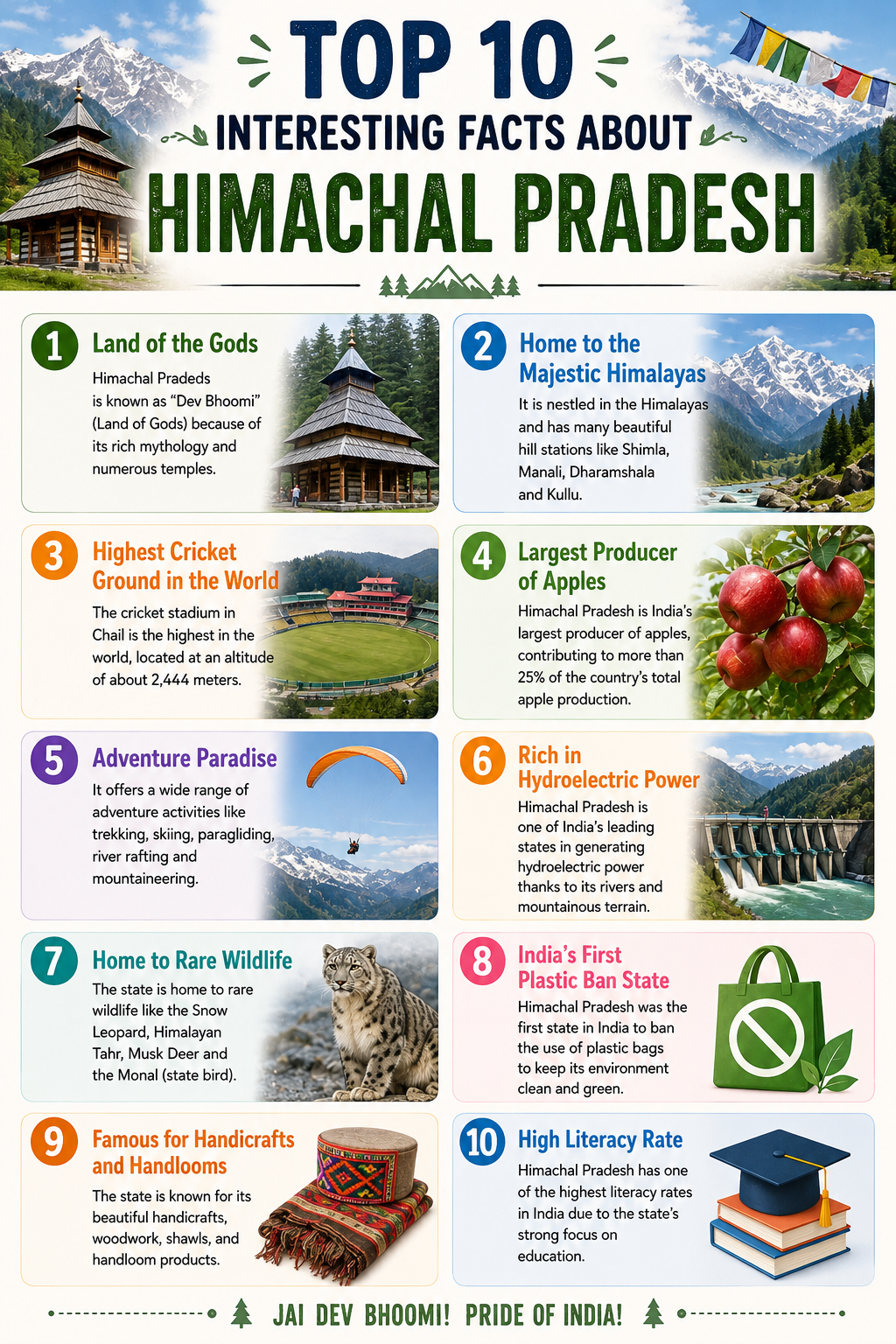
Himachal Pradesh is a land in which mountains don’t only shape the landscape, they also shape life. In the western Himalayas the state is tranquil, slow, and deeply rooted to nature. The snow-covered peaks, the dense forests and winding rivers tranquil villages make up the rhythm of Himachal’s. It is a place where life changes depending on the seasons altitude, tradition, and instead of neediness.
Himachal Pradesh is not only about beauty and scenic beauty. It has ancient traditions with strong values for community members spirituality, as well as incredible resilient. From deserts at high altitude to vast valleys of lush vegetation, the state is home to diverse contrasts that coexist. We’ll look over these top 10 interesting facts about Himachal Pradesh and understand the reasons why it’s among India’s most distinctive and loved regions.
1. Himachal Pradesh Is Known as the “Land of the Gods”
Himachal Pradesh is commonly referred to as Dev Bhoomi, which means “Land of the Gods.”
In the state, there are a multitude of temples, many which are located in mountainous areas that are remote. Local gods play an integral part in village celebrations, life and also in decision-making. The faith here isn’t limited to temples, but is integrated into everyday activities, rituals for the seasonal season and gatherings of the community. Spirituality in Himachal is lived, not visible.
2. The State Has Extremely Diverse Geography
Himachal Pradesh may look uniform on a map, however geographically, it’s incredibly varied.
The state has lush green valleys, like Kullu and cold deserts like Spiti dense forests, glaciers rivers, as well as high mountain passes. The elevations range from around 350 m to more than 6000 metres above sea-level. This range of elevations creates stark variations in the life style, climate and farming within the shortest distances.
3. Himachal Pradesh Has One of India’s Highest Literacy Rates
Himachal Pradesh consistently ranks among the most literate Indian states for literacy.
Education is a priority even in the most remote of villages. Schools are widely available and families are strongly promoting the education of both girls and boys. The emphasis on education has allowed the state to maintain stability in the social sphere, reduced crime rate, as well as a heightened civic consciousness.
4. Apple Farming Changed the State’s Economy
Himachal Pradesh is one of the largest producers in India of apples..
Before the growth of apple orchards agriculture options for the hills were a bit limited. Apple orchards changed the rural lifestyle with steady earnings and job opportunities. Apples remain closely tied with the identity of the nation, its economy, and rhythms of the season.
5. Shimla Was Once the Summer Capital of British India
Shimla is the capital city of Himachal Pradesh, was an official Summer capital of British India.
The British changed their headquarters to Shimla in summer in order to escape the scorching heat of the plains. Many of the colonial-era churches, buildings and other institutions remain even today. Shimla’s architecture, layout and old-fashioned charm are a reflection of this rich and varied history.
6. Himachal Pradesh Has Strong Community-Based Living
Life in the village of Himachal Pradesh is deeply community-oriented.
People rely on one another through harsh winters road closures, winter storms, and natural disasters. Shared decision-making, shared holidays and mutual support are all common. The strong social fabric can help communities to survive tough times and ensures peace.
7. The State Is a Major Hydropower Producer
Himachal Pradesh plays a significant part for india’s energy generation.
Rapidly flowing rivers such as those of Sutlej, Beas, Ravi and Chenab offer ideal conditions to develop hydroelectric power projects. These projects supply energy to many regions of northern India and make Himachal an important state for energy despite its tiny population.
8. Himachal Pradesh Preserves Ancient Tribal Cultures
Regions such as Lahaul, Spiti, and Kinnaur are home to many ancient tribal communities that have distinctive practices as well as lifestyles, languages, and customs.
They have developed to withstand the extreme temperatures, isolated or high altitude. Food, festivals, clothing practices, and even architecture are a reflection of the evolution of these cultures rather than a luxurious. Even in the present, these regions remain untouched by the passage of time.
9. Tourism Is Important but Carefully Balanced
Tourism is an integral component of the economy of Himachal Pradesh which draws tourists to destinations such as Manali, Dharamshala, and Kasol.
In parallel there is a growing awareness of sustainable tourism. Locals are increasingly focusing on the protection of forests, limiting overdevelopment and maintaining the balance of nature. Nature isn’t just an attractive feature here, it is an absolute necessity.
10. Life in Himachal Is Closely Tied to Nature’s Rhythm
The region of Himachal Pradesh, the seasons determine everything: food, work as well as travel and festivals.
Winter brings reflection and isolation. Summer is a time for movement and trade. Roads are open and close when there is snowfall. Crops are based on mountain timing and not calendars. This connection to nature can teach patience, resilience as well as respect to forces that are beyond human control.
Conclusion
Himachal Pradesh is not just an attractive destination, it is an approach to life that is shaped by the mountains, the weather, and customs. People in the region are aware that nature provides and takes according to its own rules. It’s not difficult to find simplicity here. is harmony.
In an ever-changing world, Himachal Pradesh stands as an example that advancement does not always imply speed. Sometimes, it’s about being grounded by respecting nature and letting the world unfold according to its own rhythm.