





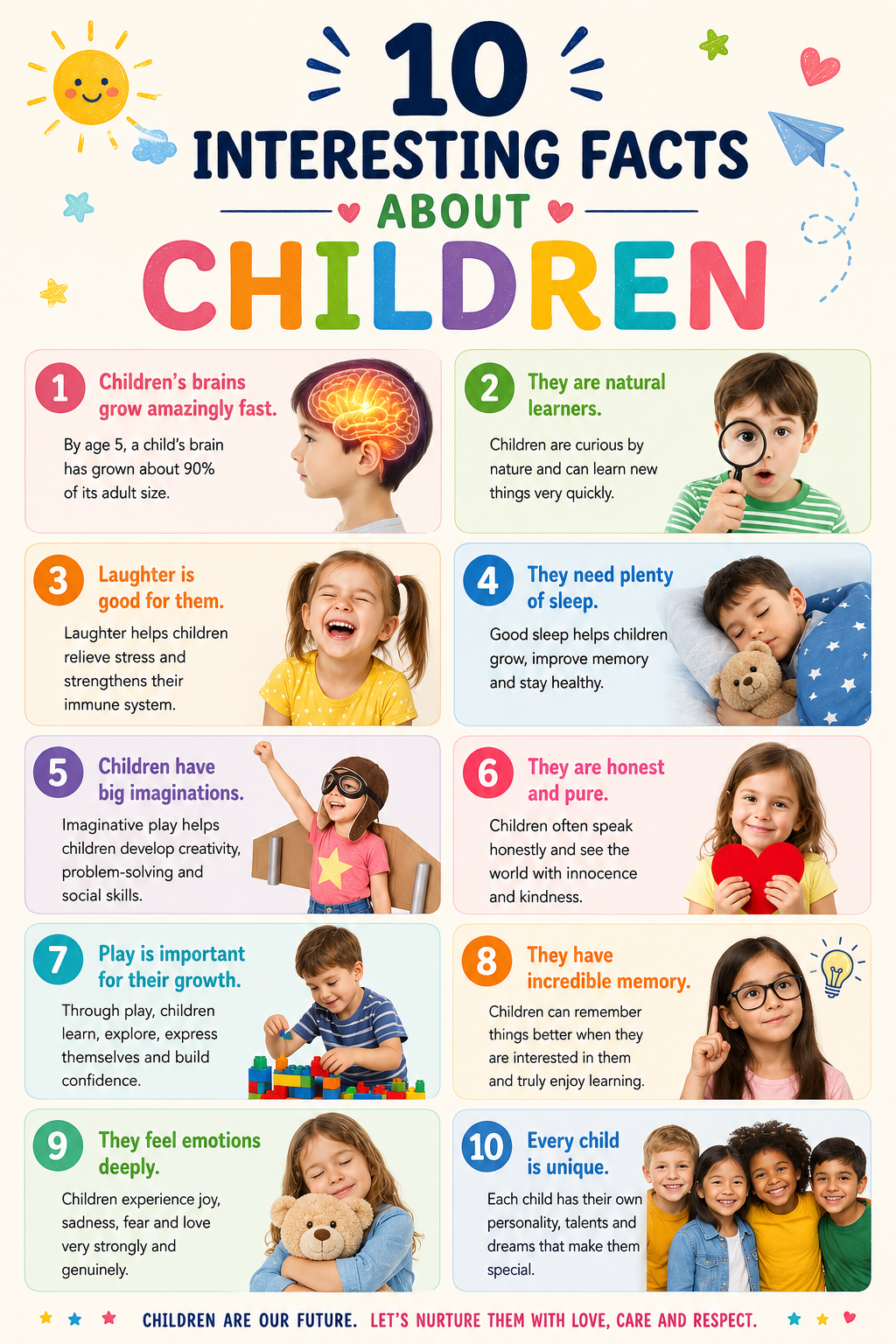
Children see the world differently than adults. What is normal to adults can be exciting, new and meaningful to young children. Their minds are always exploring, experimenting as well as copying and imagining. Every question they ask or activity they engage in are a part of their understanding of the world around them.
Children aren’t “unfinished adulthood.” The children are active learners who have their own unique logic, emotions and perspectives on the world. Neuroscience, psychology and research on education continue to reveal how complex childhood truly is. These ten facts demonstrate how children are much more adept, interesting, and sensitive than we usually think.
Top 10 Interesting Facts About Children
1. Children’s Brains Grow Faster Than at Any Other Time
As a child the brain develops an astonishing rate. At the age of five children’s brains reach around 90 percent that of the size it has attained as an adult.
The neural connections develop quickly as children learn to see and hear, feel as well as interact with their surroundings. This is why early experiences–positive or negative–have a lasting impact. Childhood isn’t just an incident in the course of time; it is the basis upon which all the rest is created.
2. Children Learn More Through Play Than Instruction
Play isn’t a distraction from learning. It can be learning.
Playing with children, they develop problem-solving, creative thinking as well as emotional regulation and social abilities. Games aid in understanding rules that govern cooperation, rules, and the consequences they face naturally. Studies show that children learn more through play-based learning rather than rigid learning or pressure.
3. Children Feel Emotions More Intensely Than Adults
Children are more sensitive to emotions and have greater intensities because their brains still developing their emotional control systems.
A tiny disappointment can be overwhelming. Small successes can be amazing. They’re not fawning over the details, they are simply being truthful. As time passes the brain learns to manage emotions and rational thought. In the meantime, emotions often play the role of the leader.
4. Children Are Natural Observers and Imitators
Kids learn more by what adult do rather than what adults speak about.
They watch their behavior and tone, reaction, and their habits with a keen eye. This is the reason why kindness respect, patience, and kindness that children show to each other often influence them more profoundly than lessons or regulations. Children mimic life, not rules.
5. Curiosity Is a Survival Skill for Children
Children are constantly asking questions as curiosity is a way to survive and develop.
The question “why” assists them in understanding the relationship between danger and the meaning. Curiosity helps build intelligence and confidence. If curiosity is encouraged, children learn better. If it’s not it’s easy for fear to replace curiosity.
6. Children Have Stronger Imaginations Than Adults
Children can transform everyday objects into complete worlds. A stick transforms into the sword. A box is transformed into a spaceship.
It’s the power of your brain. The practice of imagination can improve problem-solving emotion-based expression, problem-solving, and even creativity. Adults tend to lose this ability because routine takes over imagination.
7. Children Understand More Than They Can Express
Many children are aware of and feel things for a long time before they can communicate them with words.
The gap in understanding and expression could cause frustration or a lack of communication. If a child is unable to express something doesn’t mean they don’t feel strongly about it. The importance of listening patiently is greater than attempting to explain it.
8. Children Thrive on Consistency and Safety
Children feel safe when their life seems regular.
Regularity, clear boundaries and emotional security allow children to relax and develop. If children are secure their minds are focused on creativity and learning instead of surviving. Stability doesn’t limit children, it lets them be free.
9. Children Are More Resilient Than We Think
Children are incredibly able to adjust.
With love, support, and reassurance, children are able to overcome setbacks more quickly than adults. The fact that they are resilient doesn’t mean they’re not affected, it just means they require guidance, not pressure to heal and develop.
10. Childhood Shapes the Adult More Than Adulthood Does
Many of the adult behaviors as well as strengths, fears, and weaknesses can be traced back to childhood experiences.
Empathy, confidence, trust and emotional health typically start early. Childhood doesn’t go away. It becomes an integral part of who someone is. The way kids are treated today creates the society of tomorrow.
Conclusion
Children aren’t simple creatures who pass time before reaching adulthood. Children are engaged learners and emotional explorers and keen observers of the world that surrounds them. Their curiosity, play and responses are indicators of development, not weakness.
If adults slow down long enough to be able to comprehend children, they will realize the importance of childhood: it isn’t a way to prepare for the future. The childhood is the life itself, and it takes place in its most authentic and authentic form.