





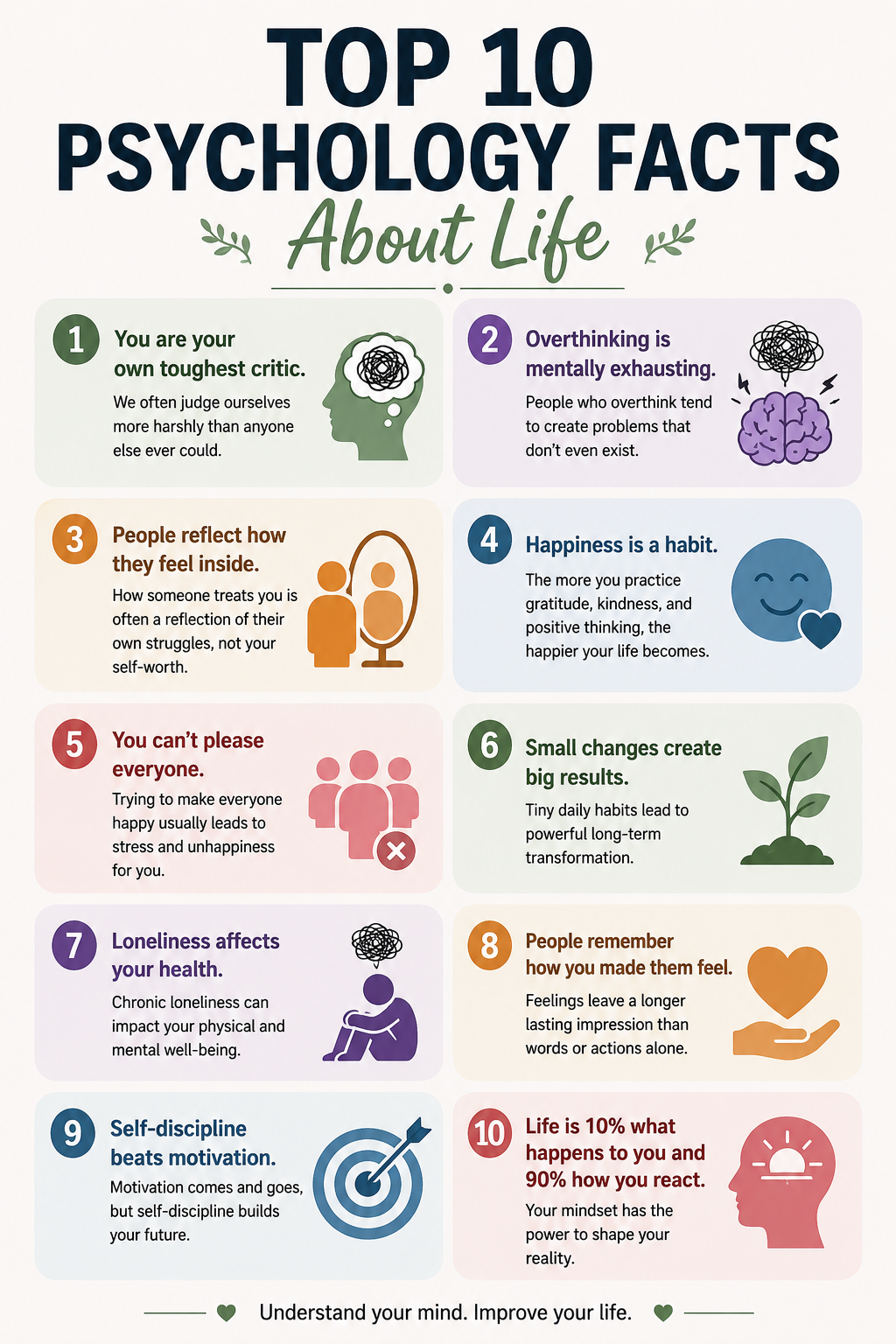
Life is complicated, not because life is complicated, but because humans are a complex mind. Two people could be in the same event and come away with different feelings, experiences and interpretations. The reason for this is because of psychology. Psychology is the secret system that shapes the way we think, feel and react, love, anxiety, and change.
Psychology isn’t just about therapy or mental illness. It is a subtle influence on our daily lives and the reasons we think too much in the night, why we are able to trust people in a flash while we make the same mistakes over and over again, and the reason why happiness can feel only temporary. Learning a few mental truths about life won’t fix everything, but it does help people navigate their lives with more consciousness and less confusion.
These top 10 Psychology Facts About Life will show how the human brain is working in everyday life sometimes without our realizing it.
1. Your Brain Is Designed to Notice Negatives More Than Positives
Human brains naturally pay more focus on negative experiences more than positive ones. This is known as the negativity bias.
From an evolutionary standpoint it makes sense. The ability to remember danger helped the early human race stay alive. In modern times it is a fact that one complaint can be more powerful than ten compliments. A negative experience can reverberate on your mind for a long time while positive moments disappear quickly.
That’s why happiness takes effort. It’s not because the world is generally bad; it’s just that the brain is more focused on problems than peace, unless we deliberately shift our attention.
2. Overthinking Is a Sign of Intelligence–but Also Stress
People who are deeply thinking often replay conversations, envision future outcomes, and then analyze previous decisions. This is an indication of their cognitive abilities but it can also increase anxiety.
The mind is attempting to control and predict the future in order to feel secure. However, since life is unpredictable and unpredictable, worrying about the future rarely leads to peace. It is only a source of mental fatigue.
The study of psychology shows that clarity does not come from thinking more, but rather from being able to recognize when it is time to stop thinking.
3. Your Emotions Influence Decisions More Than Logic
People believe that they make rational decisions. However, in reality, emotions typically make the decision first, while logic is a second factor.
Between relationships, to professional decisions emotions guide our decisions in a quiet way. Even if we believe we’re being rational, our emotional beliefs tend to determine what we think is “reasonable.”
Knowing this can help reduce guilt. In the end, poor decisions don’t necessarily indicate weakness. They simply mean that you’re human.
4. Comfort Zones Shrink Life Without You Noticing
The brain is a lover of familiarity. It favors familiarity over unexplored growth. This is why many people remain in unhappy employment, toxic relationships, or avoid routines.
The brain interprets the risk of change, even when it results in improvement. As time passes, the process of avoiding discomfort decreases confidence and opportunities.
It is uncomfortable since it is a process that requires the brain to change its wiring. The feeling of discomfort is usually an indication that something new is developing.
5. Loneliness Hurts the Brain Like Physical Pain
Research has shown that loneliness and social rejection stimulate those brain parts that are triggered by physical suffering.
Humans are wired for connectivity. The effects of isolation don’t stop there. It impacts sleep, immune system and focus as well as longer-term health.
This is the reason why neglect of emotions can be more destructive than words of reprimand, and why relationships that are meaningful are crucial and not a luxury.
6. Your Brain Believes What You Repeatedly Tell It
Self-talk creates your identity. The repetition of thoughts such as “I’m insufficient” as well as “I never succeed” helps the brain accept these thoughts as true.
The brain doesn’t have to question repetition; it absorbs it. As time passes, the beliefs transform into actions.
The reason for this is that changing your life often begins with changing the our inner dialog. It’s not fake positivity however, but genuine, positive thinking.
7. Memories Are Not Accurate–They Are Reconstructed
Each time you recall some thing, your mind alters it in a small amount. The way you remember things is influenced by your current beliefs, emotions as well as experiences that have occurred later.
This means that two people may recall the same event differently, yet they both believe that they’re correct.
This knowledge can reduce unnecessary conflict. Memory isn’t a recording It’s reconstruction.
8. Happiness Is Linked More to Meaning Than Pleasure
The pleasure is good It’s a good feeling, but it wears off quickly. The feeling is longer.
Psychology has shown that people are more satisfied when their lives are focused on helping others, advancing, learning or contributing, rather than seeking perpetual comfort.
This explains why a successful life without meaning feels hollow and why the struggle to achieve the goal of achieving it can feel rewarding.
9. The Mind Calms Down When the Body Moves
Physical exercise directly impacts mental wellbeing. Walking or exercising decrease stress hormones and boosts the levels of mood-regulating chemicals.
The body and brain aren’t separate systems. When the body relaxes then the mind is the next to release tension.
This is the reason why many people have more clarity when walking, and feel more relaxed after a walk.
10. Most Life Regret Comes From Things Not Done
Psychological research has proven that regret over the long term is most often due to missed opportunities as opposed to mistakes made.
People are embarrassed by not speaking out, not trying to express love, or taking risks. Fear is a shield in the short run but causes regret over the long run.
It doesn’t mean that you should be reckless, but it can mean that delay and silence often will cost you more emotionally than a failing.
Conclusion
The mind is multi-layered and emotionally ad protective. Psychology can’t eliminate anxiety or fear but it does help to understand why we feel how we do.
Knowing these mental patterns will give you an advantage that is powerful that is awareness. This awareness leads to choices. If you are aware of your mind, it doesn’t change, but it is more clear and calmer. It becomes more manageable.